Want to learn about bat conservation research in Bangladesh? Dr. Ashraf’s got you covered! Watch his GBatNet “My Field for Dummies” webinar, available now on YouTube (science made simple)
The Kingston Lab is happy to share a new publication from Ashraf and Tigga, just out in Biodiversity and Conservation. This work examines how small-scale habitat modification within protected forests can affect bat communities and activity, even before extensive forest loss occurs.
One of the key questions of the Anthropocene is how habitat fragmentation affects biodiversity. While fragmentation has been widely studied, much less attention has been given to its earliest stage, known as habitat perforation. Habitat perforation occurs when small clearings appear within otherwise unmodified forests, creating edges and gaps that alter the natural forest structure. Although recognized for more than three decades, its effects on biodiversity inside protected areas remain poorly understood.
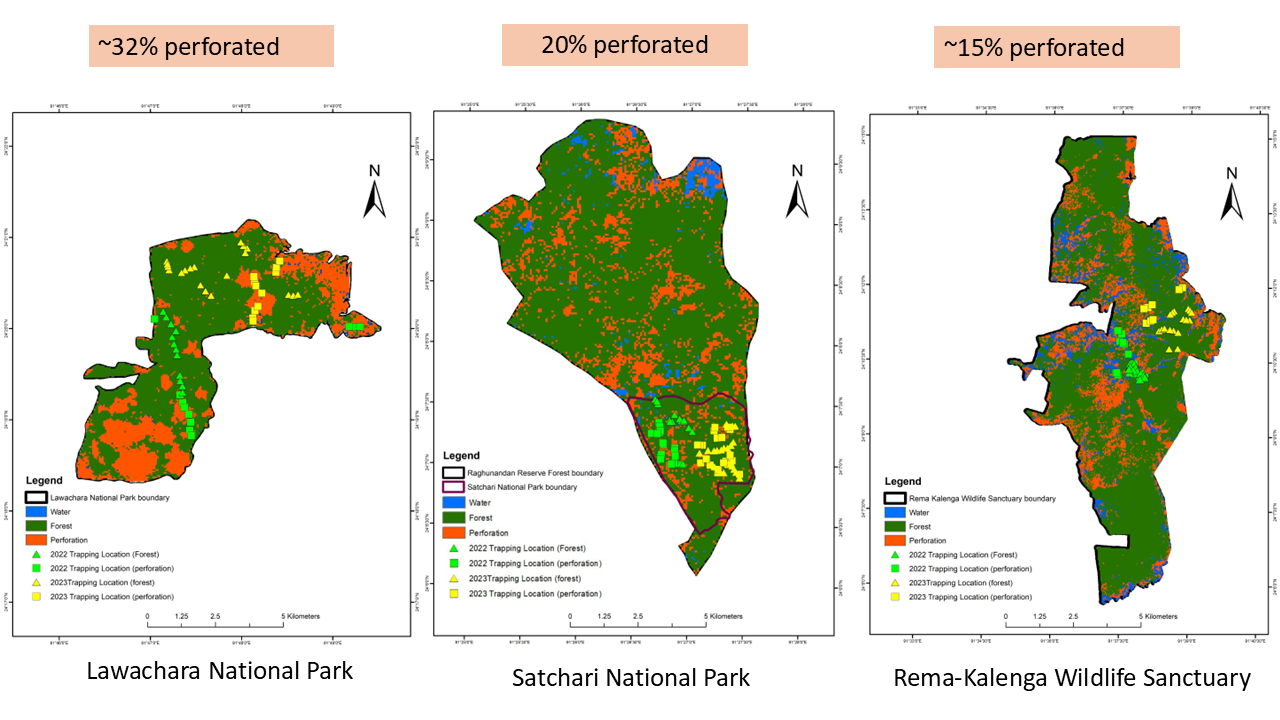
Protected areas in northeastern Bangladesh have already been perforated by human activities. Depending on the protected area, agroforest perforations cover about 15–32% of its total area. These perforations result from commercial and small-scale agriculture, selective and illegal logging, land clearing, and human settlements.
We examined how habitat perforation within protected areas and tea plantations outside them influences bat communities in three protected areas of Bangladesh. We found that bat diversity was highest in unmodified forests. Although perforation had not yet fully altered the overall bat community, perforated habitats created opportunities for bats that forage along forest edges, in gaps, and in open spaces, while gradually filtering out bats that depend on undisturbed forest interiors. We also found that bat acoustic activity was highest in tea plantations, largely because these habitats were dominated by edge- and open-space foraging species.
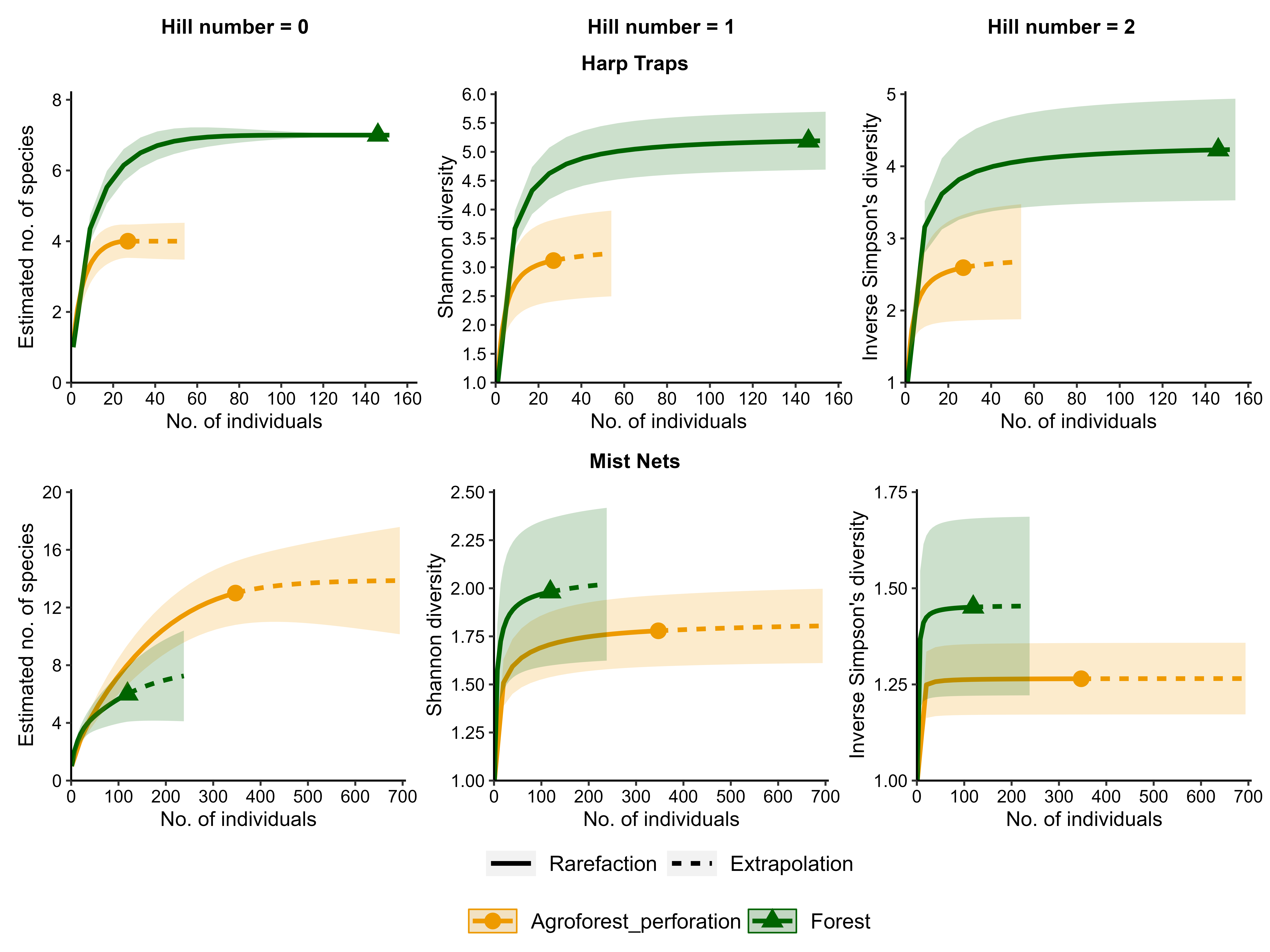
The rarefaction and extrapolation curves compare estimated bat diversity between unmodified forest (green) and agroforest perforations (orange), based on captures from three protected areas in Bangladesh. Harp trap results are shown in the top row, and mist net results in the bottom row. The x-axis shows the number of bats captured, and the y-axis shows estimated bat diversity. Harp traps detected greater bat diversity in forest sites across all three measures: species richness (Hill number 0), Shannon diversity (Hill number 1), and inverse Simpson diversity (Hill number 2). Mist nets captured greater species richness (Hill number 0) in agroforest perforations, but forest sites showed higher Shannon and inverse Simpson diversity (Hill numbers 1 and 2) when species abundances were considered. This suggests that mist net captures in agroforest perforations included more species but were dominated by a few abundant species. Although the differences were not conclusive, the two complementary trapping methods together suggest that even small, human-modified agroforest clearings within protected forests may be associated with early changes in bat diversity.
Our findings highlight the importance of identifying and preventing new perforations within protected areas before fragmentation becomes more severe. Protecting structurally complex forest interiors and maintaining connectivity across the landscape are essential for conserving forest-dependent bats and preventing the gradual loss of biodiversity within protected areas.
The Kingston Lab is excited to share a new publication from Tigga and colleagues and published in Conservation Biology. This work took considerable time and careful thought to bring together. We’re very pleased to see it published and available to the wider bat research community, with important implications for wildlife research, field safety, and One Health.
The study analyzed responses from approximately 1,000 bat researchers and examined the factors influencing their intention to follow field hygiene practices, including the use of personal protective equipment (PPE). Overall, the researchers found that bat researchers had a high intention to adopt field hygiene practices.
Mentors were the most influential source of encouragement, followed by regulatory bodies, fellow researchers, and mentees. The study also found that perceptions that hygiene practices were impractical or uncomfortable were important barriers to their adoption.
A structural equation model of drivers of the intent to adopt field hygiene (FH) behaviors by nondisease bat researchers. The model is built around the Theory of Planned Behavior, and as can be seen here, intent to adopt field hygiene is strongly influenced by the subjective norm and perceived behavioral control.
We found that bat researchers recognize and accept the importance of protecting both bats and people and of preventing cross-contamination of samples. The findings highlight the significant role of senior researchers in modeling good field hygiene practices and encouraging students and early-career researchers to follow them. This study also emphasizes the need for education, practical solutions, and supportive policies in wildlife research.
Although the study focuses on bat researchers, its findings have broader implications for wildlife research and One Health, as fieldwork involving wild animals can create opportunities for pathogen transmission. Therefore, promoting strong field hygiene practices across the wildlife research community can help protect researchers, wildlife, and public health.