Touseef posed in front of his poster titled “Future directions for One Health Research; Regional and Sectoral Gaps“
A competitive Travel Award by the Congress Organizing Committee enabled Touseef to attend the 7th World One Health Congress in Singapore to present his research “Future directions for One Health Research: Regional and Sectoral Gaps”. The concept of One Health highlights the important inter-relationships between health and well-being of people, animals, plants, and the environment which supports their existence. However, implementation of a One Health approach varies considerably between different geographical regions and remains challenging to implement without greater inclusivity of different disciplinary capacity and expertise. Identifying regional and sectoral gaps will help achieve One Health research parity.
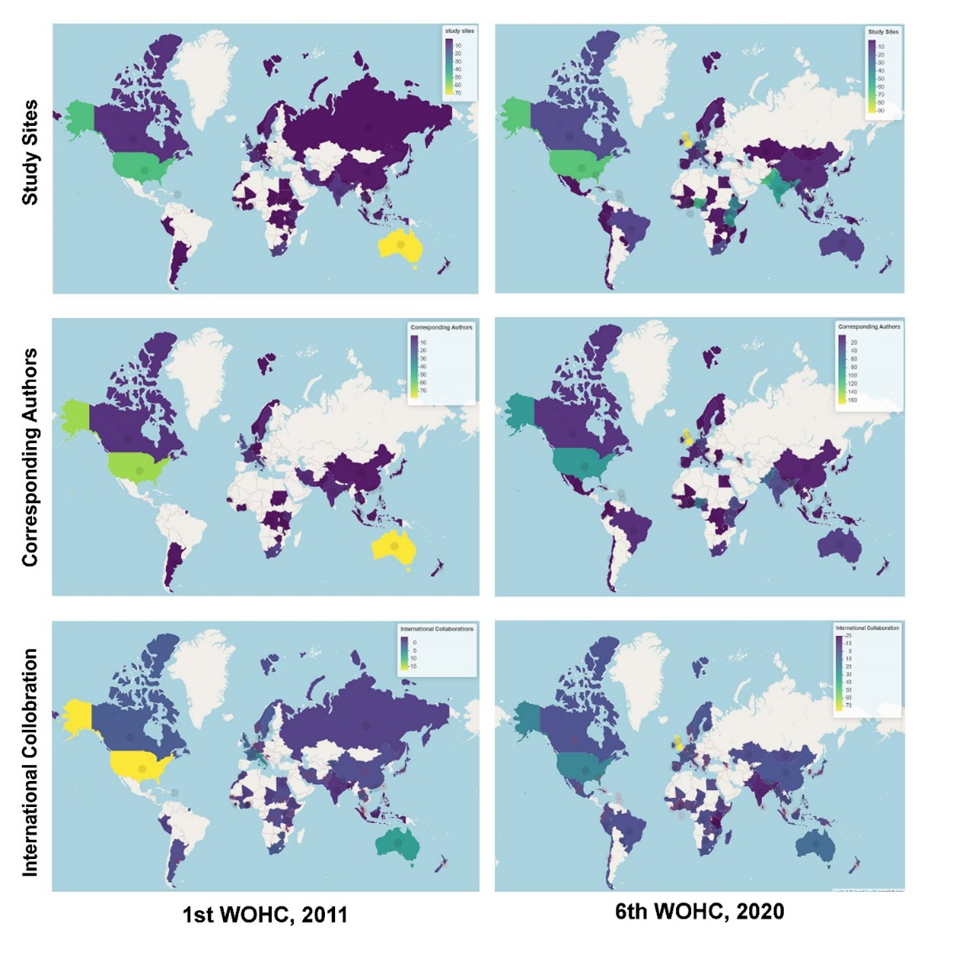
Geographic distribution of One Health research. Comparison of abstract distributions from 1st and 6th World One Health Congress based on study sites, affiliation of corresponding authors, and international collaborations. Contributions to international collaborations were calculated as the difference between the number of studies conducted in the country and the number of corresponding author affiliations from the country. Negative and positive values indicate sink (received collaboration) and source (extended collaboration) of One Health research. Source countries such as US and UK for the 1st and 6th WOHC are indicated by yellowish green color while sink countries such as India and Pakistan for both Conferences are indicated by dark blue color. Check out our interactive web maps here!
Bat research is limited in Bangladesh, so to date estimates of bat diversity in the country have been based on a few ad hoc studies and expert opinion. To gain a more complete understanding, Ashraf compiled species occurrence data from the literature, museum records and the Global Biodiversity Information Framework (GBIF). He set out to confirm species presence and identify species that might be expected to occur in Bangladesh based on occurrence records in neighboring countries and habitat preferences. To visualize the distribution of bats, Ashraf made maps for each species recorded from Bangladesh and species that might occur in the country.
He found a total of 31 species are recorded for Bangladesh – but only 22 are associated with voucher records. Evidence for nine species came from photographs and/or human observation. An additional 81 species were recorded from surrounding countries. Of these, 38 species are highly likely to occur in Bangladesh.
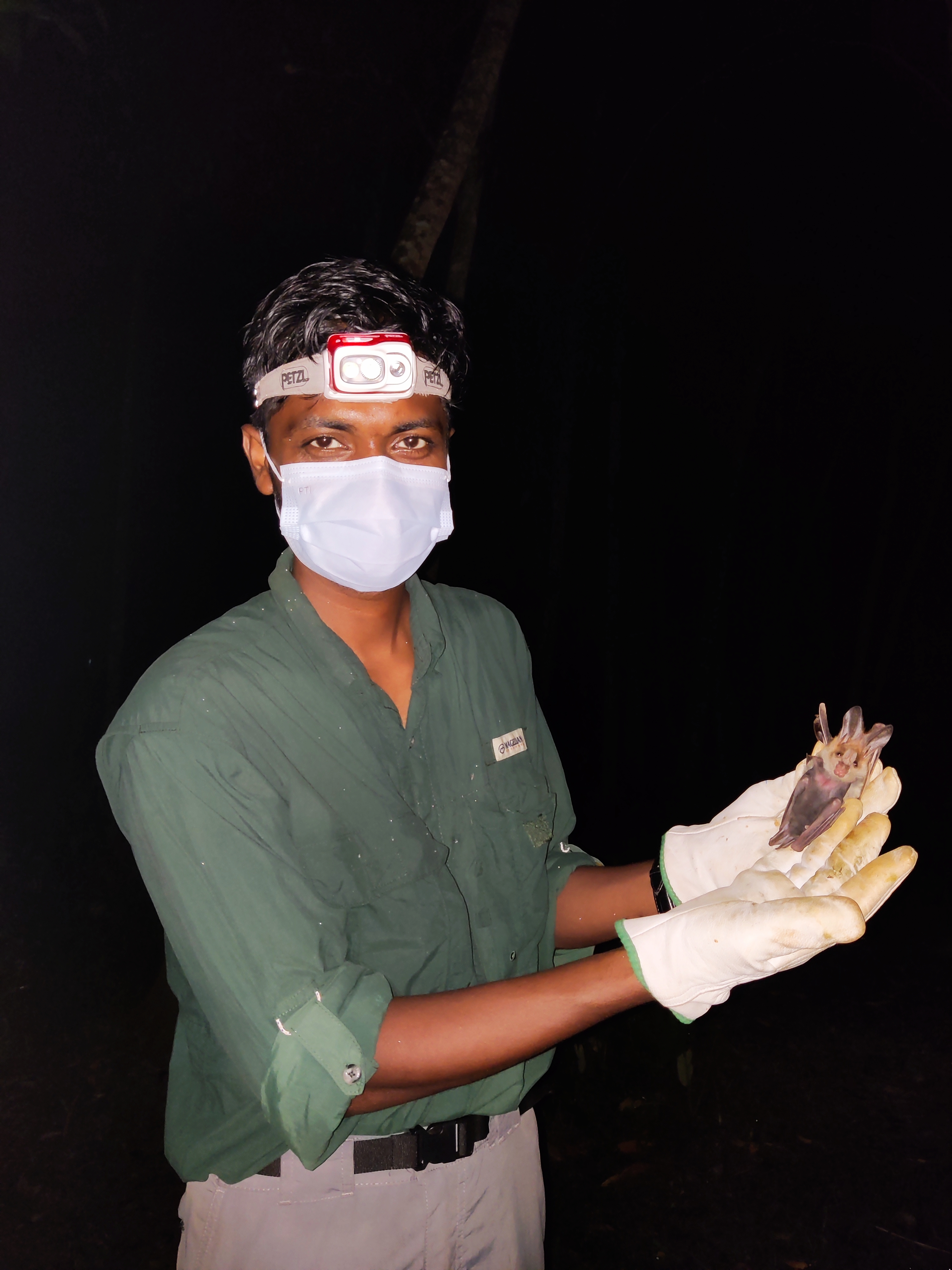
Ashraf holding a female Greater false vampire bat (Lyroderma lyra) carrying its pup captured from his study site in Bangladesh
So what is next? To expand the country list, Ashraf recommended that surveys of bats in Protected Areas, caves and wetlands be prioritized. Surveys should use multiple methods, including contemporary techniques (harp traps and acoustics) that have not been used in Bangladesh before, as well as traditional ones (mist nets). He emphasized that voucher specimen collections are needed to confirm the presence of and distribution of bats in Bangladesh and identify areas central to bat conservation.
The locality records based on Ashraf’s study show the distribution of Greater false vampire bat (Lyroderma lyra) in Bangladesh
Citation: Ul Hasan, M. A., & Kingston, T. (2022). Bats of Bangladesh—A Systematic Review of the Diversity and Distribution with Recommendations for Future Research. Diversity, 14(12), 1042. https://doi.org/10.3390/d14121042


 Kingston Lab