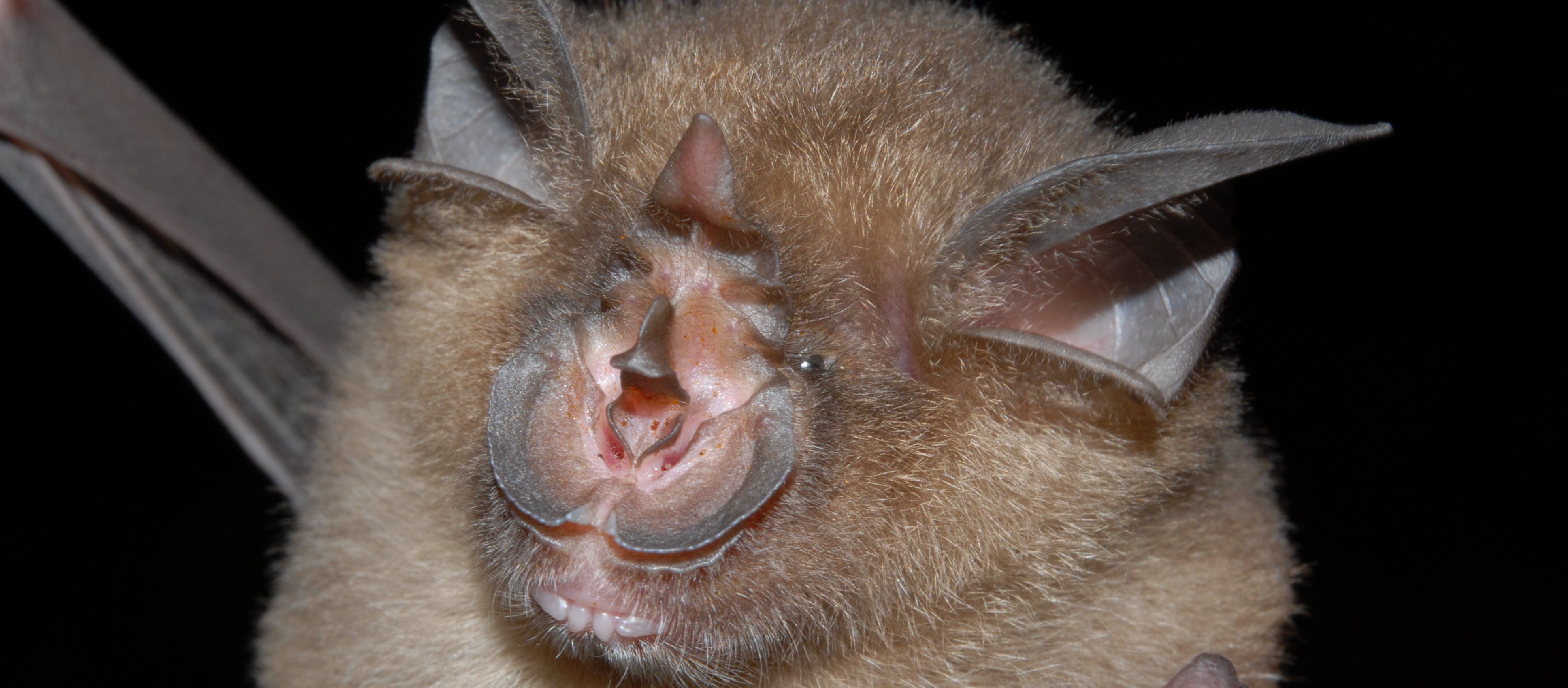
New Paper: A machine learning framework to classify Southeast Asian echolocating bats

The publications keep coming! Tigga and Joe are co-authors on “A machine learning framework to classify Southeast Asian echolocating bats” that just came out in Ecological Indicators. This paper has all you can ask for, if what you’re asking for is using machine learning to classify bat calls in Southeast Asia. Field rats take note: “Our framework allows users to rapidly filter acoustic files for common species and isolate files of interest, cutting the total volume of data to be processed by 86%.” Not only a time saver, but this increases the capacity of researchers to use non-invasive sampling in regions without species-specific call records and can detect species that are often missed when employing other sampling methods.

The four call types used in the Borneo bat classifier and representation of bat ensembles in Borneo, their corresponding call types, and species/sonotypes used to train the bat call classifier.

Ten New Bat Records from Nigeria!

Iroro, Ben, and Tigga recently published ten new species-level bat records from Afi Mountain Wildlife Sanctuary and Cross River National Park in southeastern Nigeria. These new records are especially exciting because Nigeria is both under-sampled and a biodiversity hotspot! Check out the full publication “Hidden Afrotropical Bat Diversity in Nigeria: Ten New Country Records from a Biodiversity Hotspot“

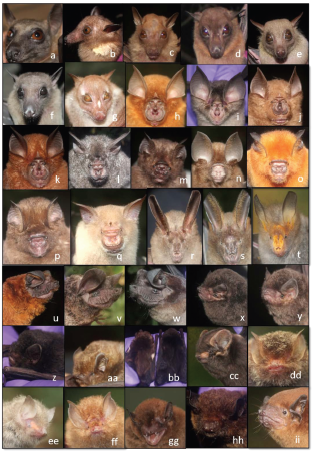
Left: Portraits of 34 bats captured during the field survey at Afi Mountain Wildlife Sanctuary and Cross River National Park. M. torquata (e), R. hillorum (j), H. curtus (n), M. inflatus (x), G. cf. humeralis (aa), G. egeria (cc), K. cuprosa (dd), K. phalaena (ff), and N. eisentrauti (hh) are all new country records.

ChiroVox online public call library and accompanying PeerJ publication are live!

ChiroVox, the home of bat recordings from all over the world!

Tigga, along with Former lab members Joe Chun-Chia Huang and Juliana Senawi, recently co-authored “ChiroVox: a public library of bat calls” in PeerJ. The paper was timed to coincide with the launch of www.chirovox.org online bat call library. The library contains calls from across three cotenants and welcomes quality call contributions to help grow this valuable community resource.

Two New Publications!

Over the last couple of months, Tigga has published a couple of new papers:

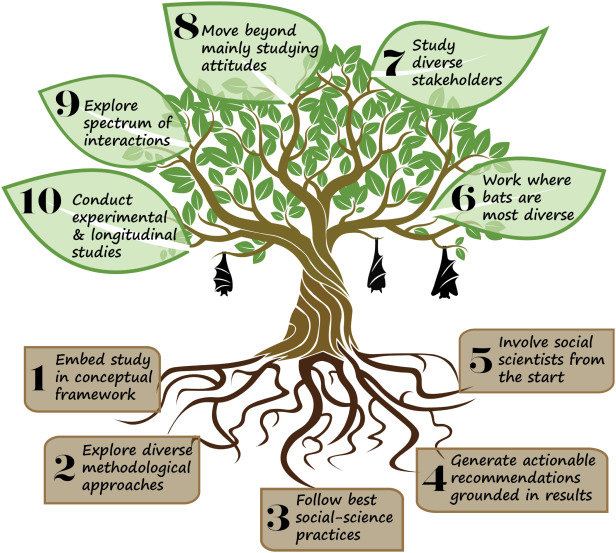
The first paper is “Human dimensions of bat conservation – 10 recommendations to improve and diversify studies of human-bat interactions”. The authors assess bat-related HD research papers and provide recommendations for how to better ground our research and directions for expansion.

Ten recommendations for to improve and diversify studies of human-bat interactions

Straka, T. M., Coleman, J., Macdonald, E. A., & Kingston, T. (2021). Human dimensions of bat conservation – 10 recommendations to improve and diversify studies of human-bat interactions. Biological Conservation, 262, 109304. https://doi.org/10.1016/j.biocon.2021.109304

The second paper is “Setting the Terms for Zoonotic Diseases: Effective Communication for Research, Conservation, and Public Policy”. The authors categorized the misuse of zoonotic terms and clarified the definitions of these terms. The paper also provided frameworks to how to correct these miscommunications.

Shapiro, J. T., Víquez-R, L., Leopardi, S., Vicente-Santos, A., Mendenhall, I. H., Frick, W. F., Kading, R. C., et al. (2021). Setting the Terms for Zoonotic Diseases: Effective Communication for Research, Conservation, and Public Policy. Viruses, 13(7), 1356. MDPI AG. Retrieved from http://dx.doi.org/10.3390/v13071356

Clutter negotiating ability of forest bats – Our paper in J Exp Biol just published

Most bat community ecologists conceptualize insectivorous bat assemblages as comprising at least three foraging ensembles — the “open-space” ensemble, the “edge/gap” ensemble and the “narrow-space” or forest interior ensemble. The ensembles are generally characterized by different combinations of wing parameters that facilitate flight in those habitats. What’s been less clear is how species differ in performance within these ensembles, and how any differences might map to wing morphology.

That’s what Julie Senawi set out to do as part of her PhD, assessing performance of 15 species of forest interior bats through a collision-avoidance. There are a number of challenges in inferring ability from performance on tests, so we borrowed form the social sciences and applied Rasch Analysis, a latent trait modelling approach related to Item Response Theory. Details of this approach and the findings were published this week and can be requested through my researchgate page:

Senawi, J. & Kingston, T. (2019). Clutter negotiating ability in an ensemble of forest interior bats is driven by body mass. J. Exp. Biol. doi:10.1242/jeb.203950

The title says it all!

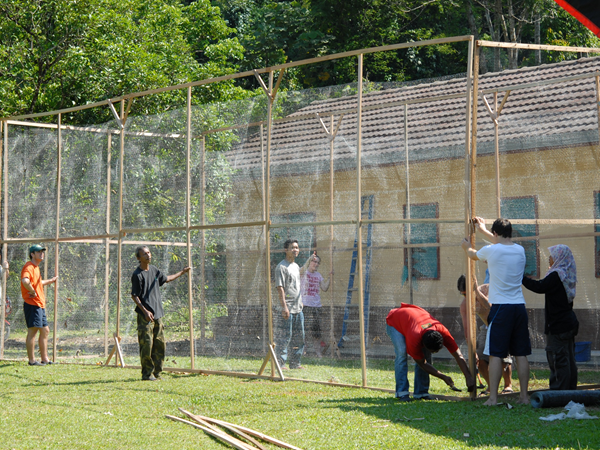
Building Julie’s flight cage
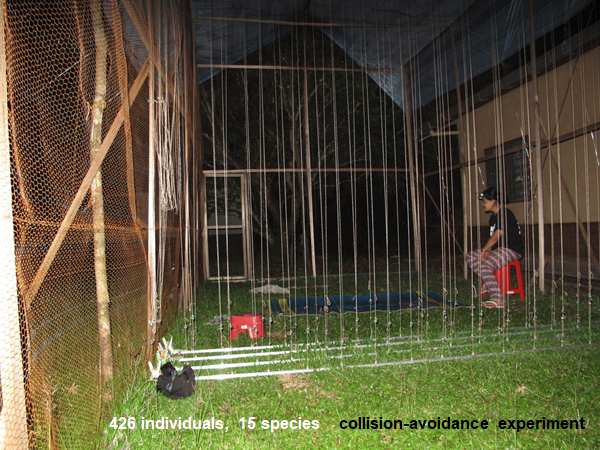
4 banks of strings that could be set to different inter-string distances made up the collision-avoidance experiment.
Julie taking photos of the bats to extract wing dimensions

Special Issue in Diversity “Diversity and Conservation of Bats” — submissions wanted!

I am the guest editor for a special issue in the journal Diversity entitled “Diversity and Conservation of Bats”. Submissions are due before 31st March 2018, so plenty of time to pull together some great papers!  The scope address the following:  i) the diversity and distribution of bats; ii) the effect of human activities (e.g., landuse change, hunting, roost disturbance, climate change) on bat behavior, populations, diversity, distributions, or ecosystem function; iii) drivers of human activities that threaten bats (e.g., attitudes, knowledge, perceptions, economics); and iv) conservation applications, particularly those that evaluate evidence of success.

For full details, head to the issue page here:

Diversity and Conservation of Bats

Kendra recently published in the journal and had a good experience with them. Once the article is accepted, it is up in the issue almost immediately, and the review process was also very efficient.  So, I look forward to seeing submissions.

Viral richness and cave roosting in bats – Kendra’s paper out today in Diversity

Kendra has a paper out today, with lead author Anna Willoughby and Kevin Olival from Ecohealth Alliance, in Diversity exploring the role of roosting ecology in patterns of viral richness and sharing among bat species. The authors compiled bat-virus associations (from previously published databases) and ecological traits to investigate the importance of roosting behavior on viral richness and sharing. Cave-roosting bats do not host greater viral richness than non-cave-roosting bats, but do exhibit a greater likelihood of sharing viruses, especially between species documented as co-roosting in the same cave.

Willoughby, Anna R.; Phelps, Kendra L.; PREDICT Consortium; Olival, Kevin J. 2017. “A Comparative Analysis of Viral Richness and Viral Sharing in Cave-Roosting Bats.” Diversity 9, no. 3: 35. doi:10.3390/d9030035

The paper is open access and can be downloaded here:  http://www.mdpi.com/1424-2818/9/3/35


Bias in Open Source Bat Data — Ecological Informatics paper out today

Marina’s first publication from her dissertation research is online today — congrats! Marina and undergraduate co-author Rebecca Wilson pulled together and cleaned a huge dataset of Southeast Asian GBIF records. Perhaps not surprisingly, Southeast Asian bat sampling effort is spatially biased, most notably by distance to protected area. However, ecology also plays a role, with bias varying among foraging groups. A particularly novel contribution to the field was examination of how bias changed through time.  The paper is OPEN ACCESS until July 5th.

Marina Fisher-Phelps, Guofeng Cao, Rebecca Wilson and Tigga Kingston. (2017) Protecting bias: Across time and ecology, open-source bat locality data are heavily biased by distance to protected area. Ecological Informatics 40: 22-34. https://doi.org/10.1016/j.ecoinf.2017.05.003.

** NOTE the current pdf on the Ecological Informatics site is missing a table. It is present in the online version. This will be corrected soon.

Ain’s paper on reproductive phenology online in Biotropica

Ain’s wonderful paper entitled “Resource availability and roosting ecology shape reproductive phenology of rain forest insectivorous bats” is available online in Biotropica DOI: 10.1111/btp.12430 (or you can request through my Researchgate page).

Ain spent 20 months tracking reproductive activity in 11 species of female bats in a Malaysian rainforest, and is the first study to simultaneously track both available insect biomass and local weather. The findings show different reproductive patterns in cave- vs. forest-roosting bats, which we suggest may be attributed to the cost of commuting.

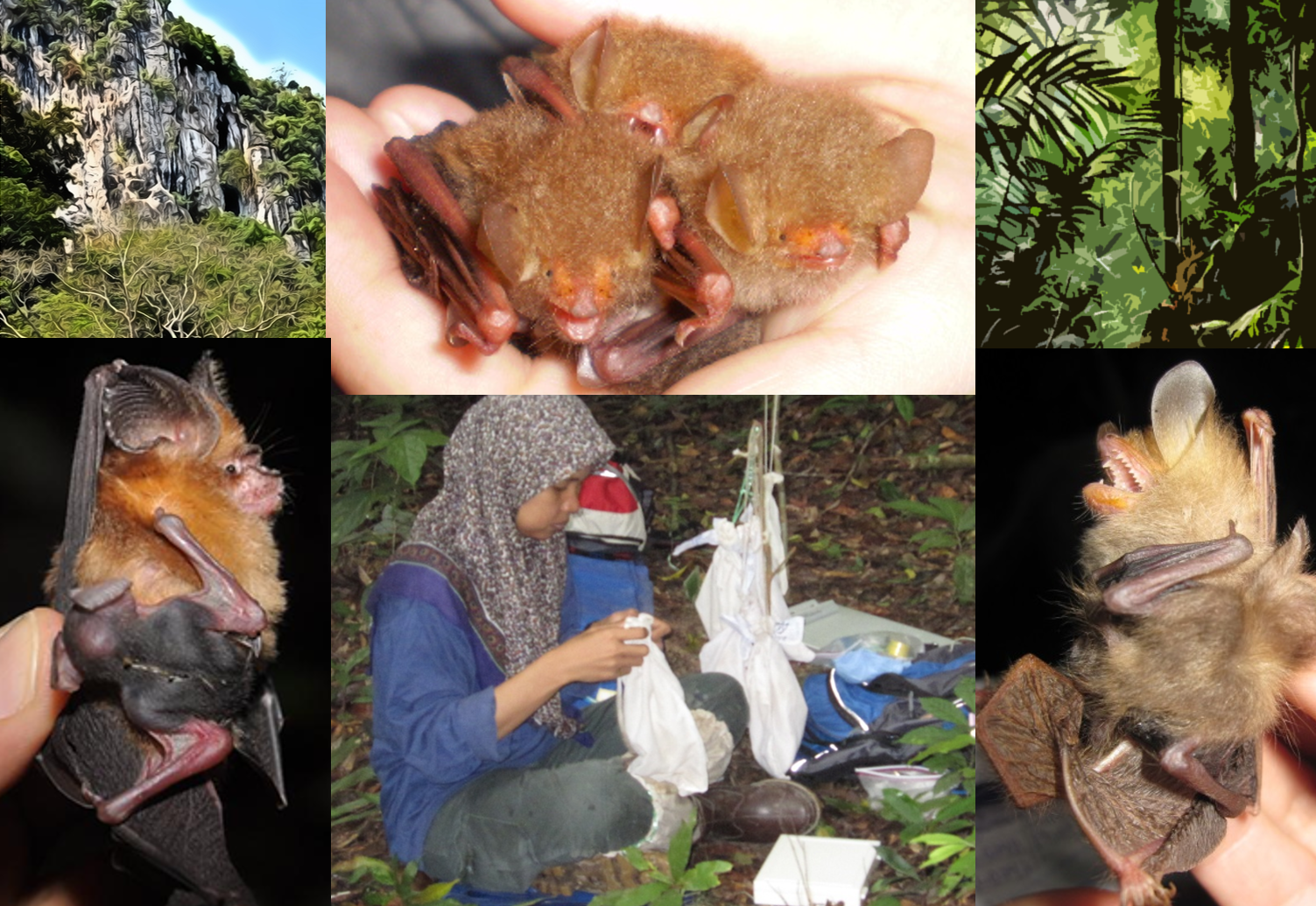
Ain hard at work in Malaysia, assessing reproductive status of cave- (bottom left) and forest-roosting (bottom right, top center) bats.

Nurul‐Ain Elias, Hashim Rosli, and Tigga Kingston. “Resource availability and roosting ecology shape reproductive phenology of rain forest insectivorous bats.” Biotropica (2017). DOI: 10.1111/btp.12430

Congratulations to Marina — Mobile acoustic transect study published in J. Arid Environments

Before Marina started working on spatial bias in species distribution models and the SEABCRU database, she spent a couple of summers exploring the efficacy of driven transects in detecting bats in the low bat-density habitats around Lubbock. In our arid, largely treeless, waterless plain (the study was conducted during a 4-yr drought), stationary bat detectors remain silent, and pretty much the only way to detect bat activity is by extending the spatial extent of sampling by driving. This has implications for others surveying and monitoring bats in arid environments, and her findings are out this week in the J. Arid Environments. This is open access until December 9th.

Marina Fisher-Phelps, Dylan Schwilk and Tigga Kingston. (2017). Mobile acoustic transects detect more bat activity than stationary acoustic point counts in an urban-rural landscape matrix. Journal of Arid Environments 136: 38-44. http://dx.doi.org/10.1016/j.jaridenv.2016.10.005

Treeless, waterless plain, where turbines abound

Treeless, waterless plain, where turbines abound. Driven transects work better than stationary points for  detecting the little bat activity.