IUCN SSC Position Statement Planned Cull Mauritius Fruit Bat
IUCN SSC Position Statement on culling of the Mauritius Fruit Bat
Reply
Congratulations to Ain on her successful defense today! Her dissertation is entitled “The Influence of Roosting Ecology and Insect Resources on the Reproductive Phenology of Malaysian Rainforest Insectivorous Bats”
Thank you to all her committee: Drs Rich Strauss, Nancy McIntyre Ken Schmidt, Jim Carr and to Caleb Phillips our Dean’s Rep.
Well done to Joe, who successfully defended his dissertation yesterday. His dissertation is titled ” Diversity and Conservation of Bats in a Coffee-forest Landscape in Sumatra, Indonesia”
Thank you to all his committee: Drs Rich Strauss, Dylan Schwilk, Nancy McIntyre and Stacy Philpott, and to Richard Stevens our Dean’s Rep. A special thank you to Stacy for doing coming all the way in from UC Santa Cruz and giving a departmental seminar (which was great).
An edited version of Iroro’s interview with BCI for the Women in Bat Conservation series from March was published in this edition of 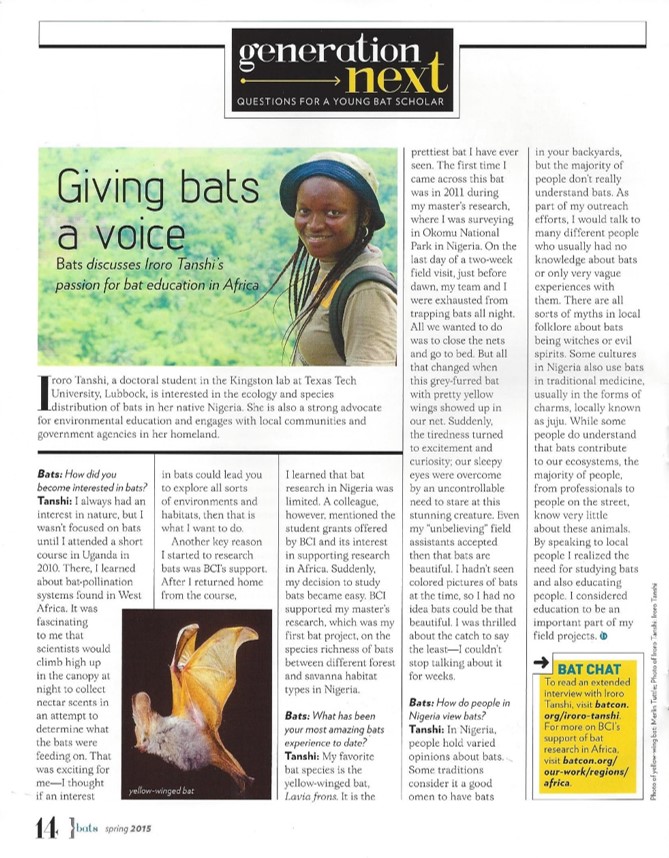 BATS magazine – great stuff.
Congratulations to Marina for being award the joint First Prize for an oral presentation in Ecology at this year’s TTABS. Her presentation was entitled “Spatial Clustering and Bias in Southeast Asian Bat Sampling Localities”. Cody McIntire did a great job presenting in the Undergraduate Category “The Diversity of Distress Vocalization of Old World Tropical Bats” and Iroro closed out the day with “High Roost Fidelity of Hammer-headed Fruit bats, Hypsignathus monstrosus, Utilizing a Man-Made Day Roost in Southern Nigeria.
Julie’s first publication from her dissertation, which went into Functional Ecology, is now available in the “Accepted Article” format here
Juliana Senawi, Daniela Schmieder, Bjorn Siemers, and Tigga Kingston (2015). Beyond size- morophological predictors of bite force in a diverse insectivorous bat assemblage from Malaysia. Functional Ecology DOI: 10.1111/1365-2435.12447
Here is the awesome “general public” summary that Julie put together for FE:
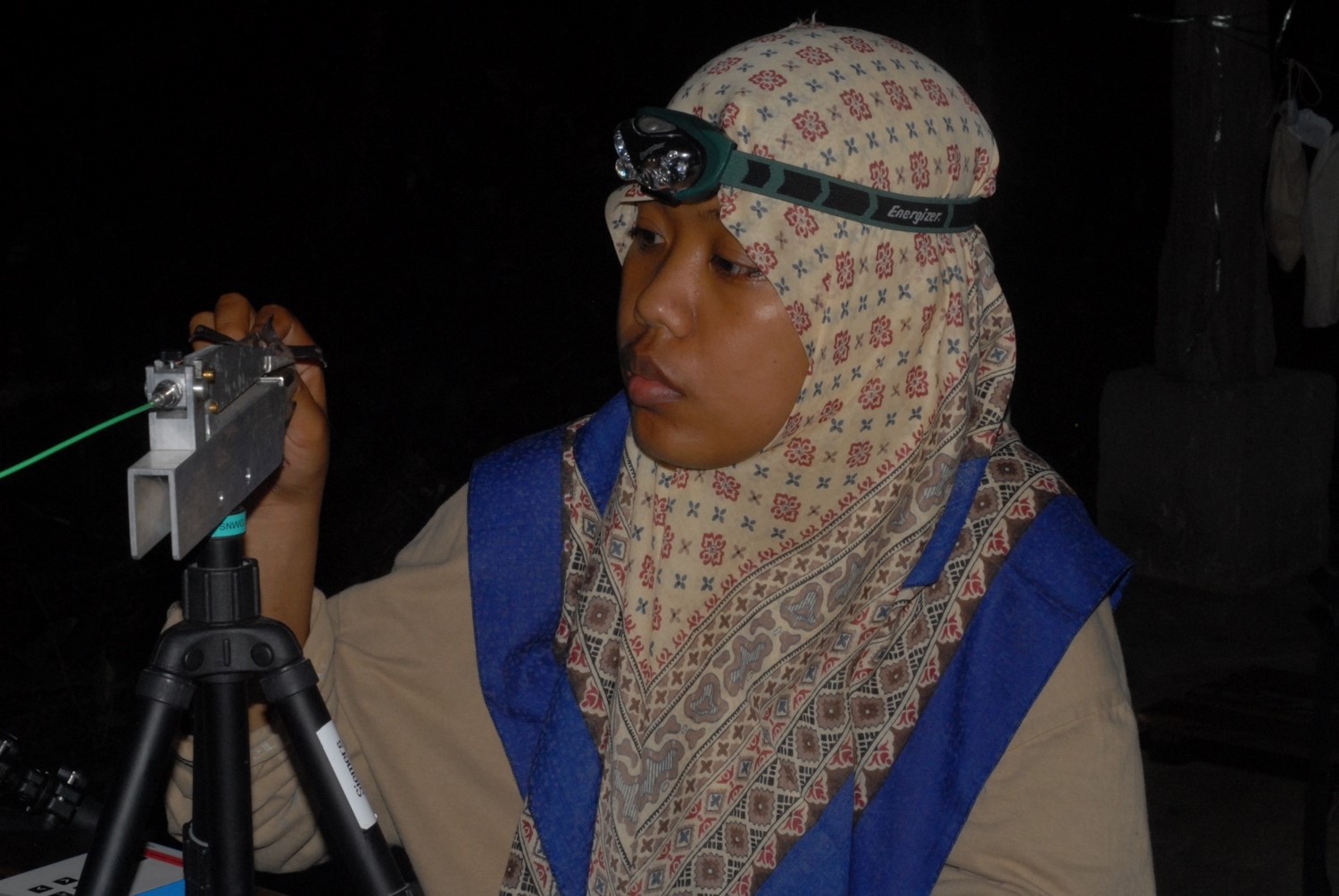
Julie gathering data in the field (looking very serious).
“Would you rather be bitten by a big dog or by a small dog? Neither, of course, but if you had to choose, which one would it be? According to researchers, bite force (bite strength) increases with size in most animals, so the small dog is likely the better bet! Previous research in South and Central America indicates this relationship holds in bats too – bigger bats bite harder than smaller bats. We wanted to test whether this was the case in Asian forests, where the bat fauna is equally diverse, but dominated by very different families of bats.
So how do we measure how hard an animal bites without losing any fingers? The bats were encouraged to bite a pair of metal plates hinged at one end by a transducer, which converts the pressure of the bite to a readable output of the force. We recorded the maximum bite force and measures of size (body mass, forearm length, head width, head height and head length) of 35 insect-eating bat species captured in Krau Wildlife Reserve, Malaysia. The bats ranged in size from 3 g to 200 g and belonged to 7 families. We also measured jaw features responsible for generating bite force using museum specimens of the same species, and used these to calculate the mechanical advantage (jaw effectiveness) adjusted by the size of the species.
So, did bigger bats bite harder? The answer was yes, but the relationship between size and bite force differed among the bat families. The effectiveness of the jaw (mechanical advantage) also played a role, regardless of the size of the bat. All 35 species of bats in this study eat insects in the same forest, so they have developed strategies to avoid competition. Having a different bite force than your neighbour may be one – while some species may focus on hard crunchy prey like beetles, others may specialize on softer fare like flying termites and moths.”
March is defense season at TTU, and we had a very busy and successful month. A hearty congratulations to Julie, Nick and Colleen for great presentations and bodies of work :-). Here are the titles:
Juliana Senawi: The Relationship between Morphology and Ecological Performance in Malaysian Insectivorous Bats. PhD Zoology. (My FIRST PhD student to graduate — YAY!).
Nick Goforth: Short-Term Effects of Wildfire on Bat Activity. MS Natural Resource Management.
Colleen Martin: Effectiveness of Operational Mitigation in Reducing Bat Mortality and an Assessment of Bat and Bird Fatalities at the Sheffield Wind Facility, Vermont. MS Wildlife, Aquatic, and Wildlands Science and Management.
Julie returns to her lectureship in Malaysia at Universiti Kebangsaan Malaysia, while Colleen and Nick will be staying on in Lubbock for a bit while they plan the next move in their careers. We wish them the very best for the future, even though they will be missed from the lab.
Iroro is today’s featured conservationist in Bat Conservation International’s “Women in Bat Conservation”. Well done Iroro!
Congratulations to Kendra for being awarded a Texas Tech University Doctoral Dissertation Completion Fellowship. This means she is fully supported to do nothing but think science and write up her research for 12 months! How cool is that!

Way Canguk in Bukit Barisan Selatan National Park — a bat diversity hotspot (photo Tigga Kingston)
Joe’s first paper from his dissertation research was published today in Acta Chiropterologica. It is a superb account of the bat diversity captured during his research in South West Sumatra and reveals the significance of the area in and around Bukit Barisan Selatan National Park as chiropteran diversity hotspot for SE Asia. Especially useful for other researchers in Sumatra is a dichotomous key to all the bat species currently known for Sumatra, based on external features. Suprisingly little work has been done on bats on the island, we hope this paper and the key will facilitate more!
Joe Chun-Chia Huang, Elly Lestari Rustiati, Meyner Nusalawo, Ibnu Maryanto, Maharadatunkamsi, Sigit Wiantoro & Tigga Kingston. A recent survey reveals Bukit Barisan Selatan Landscape as chiropteran diversity hotspot in Sumatra. Acta Chiropterologica, 15(2): 413-449.
If you would like a copy, email Joe or myself.
 Kingston Lab