Kingston Lab at the University of Illinois

Featured

After 19 wonderful years in the Department of Biological Sciences at Texas Tech University, I have moved to the Department of Evolution, Ecology, and Behavior at the University of Illinois at Urbana-Champaign as the inaugural Shelford-Pitelka-Batzli Professor in Mammalian Ecology.

Leaving behind great friends and colleagues, and the sunsets and Red Raider spirit of West Texas has been hard, but I am comforted by the warm welcome I’ve received at the University of Illinois, and excited by this new chapter and possibilities.

Kingston Lab publications in 2024 – a wonderfully collaborative year focusing on One Health, trade in bats and human dimensions of bat conservation

We had a diverse range of publications come out this year, many of which illustrate the power of integrative and large team efforts. In March, a great team of disease ecologists, bat biologists, and policy experts, led by the inimitable Professor Raina Plowright, detailed a context-dependent tiered approach to minimize spillover of pathogens from bat to human populations through protection and restoration of places where bats feed, rest and aggregate. These ecological countermeasures are laid out as a model approach for diverse taxa. Tigga and former lab member Dr Iroro Tanshi contributed.

Plowright, R.K., Ahmed, A.N., Coulson, T. et al. Ecological countermeasures to prevent pathogen spillover and subsequent pandemics. Nat Commun 15, 2577 (2024). https://doi.org/10.1038/s41467-024-46151-9

Bat field research frequently involves direct or close contact with bats, an interface that could potentially lead to spillover either from bats to humans or humans to bats. To empower the global bat research community to better protect themselves and bats, the  IUCN Species Survival Commission (SSC) Bat Specialist Group (BSG) One Health Working Group (OHWG) issued comprehensive guidelines for Field Hygiene in June of this year:

Shapiro, J.T., Phelps, K., Racey, P., Vincent a., Viquez-R, L., Walsh, A., Weiberg, M and Kingston, T. (2204) IUCN SSC BSG Guidelines for Field Hygiene. https://zenodo.org/records/12169643

The OHWG has been promoting the Guidelines through webinars, talks and demonstrations around the world, including the European Bat Research Symposium, National Bat Conference UK, 5th International Southeast Asian Bat Conference. Related, several members of the IUCN SSC BSG’s OHWG (Tigga, Wanda Markotter, Paul Racey, Lisa Worledge) contributed to a review, and something of a Public Service Announcement, of the need for bat handlers to be vaccinated against rabies.

M. Brock Fenton, Paul A. Faure, Enrico Bernard, Daniel J. Becker, Alan C. Jackson, Tigga Kingston, Peter H.C. Lina, Wanda Markotter, Susan M. Moore, Samira Mubareka, Paul A. Racey, Charles E. Rupprecht, and Lisa Worledge. 2024. Bat handlers, bat bites, and rabies: vaccination and serological testing of humans at risk. FACETS9(): 1-11. https://doi.org/10.1139/facets-2024-0056

The IUCN SSC BSG Bat Trade Working Group (BTWG) also produced a significant publication this year, with contributions from Tigga, Abby, and former lab member Dr Joe Chun-Chia Huang. The paper quantified the online trade in the US in the distinctive Kerivoula picta and received a lot of national and international attention, including coverage in the New York Times. Ultimately, it led to eBay removing all bat listings from their sites around the world (big THANK YOU eBay!).

Coleman, J.L., Randhawa, N., Huang, J.CC. et al. Dying for décor: quantifying the online, ornamental trade in a distinctive bat species, Kerivoula pictaEur J Wildl Res 70, 75 (2024). https://doi.org/10.1007/s10344-024-01829-9

Lab members also contributed to other IUCN BSG efforts, with Abby developing code to calculate EOO (extent of occurrence) and AOO (area of occurrence) used in Red List Assessments:

Monadjem, A., Montauban, C., Webala, P.W. et al. African bat database: curated data of occurrences, distributions and conservation metrics for sub-Saharan bats. Sci Data 11, 1309 (2024). https://doi.org/10.1038/s41597-024-04170-7

and Touseef leading the Red List Assessment for Pteropus medius:         

Ahmed, T., Murugavel, B., Sharma, B., Ul-Husan, A. & Salim, M. 2024. Pteropus medius. The IUCN Red List of Threatened Species 2024: e.T18725A230958344. https://www.iucnredlist.org/ja/species/18725/230958344

Related, Ben and Iroro contributed to a huge dataset of intactness estimates across Africa:

Clements, H.S., Do Linh San, E., Hempson, G. et al. The bii4africa dataset of faunal and floral population intactness estimates across Africa’s major land uses. Sci Data 11, 191 (2024). https://doi.org/10.1038/s41597-023-02832-6

Finally, two papers focused on human sentiments towards bats. The first was led by Amir Batrice, a former undergraduate researcher in the lab who worked with Abby to explore how people in Asia respond to posts of bat exploitation on social media:

Batrice, A. A., Kingston, T., & Rutrough, A. L. (2024). Measuring Asian Social Media Sentiments Toward Bat Exploitation. Anthrozoös37(4), 619–635. https://doi.org/10.1080/08927936.2024.2345474

The second took a deeper dive into the role of emotions towards bats, focusing on how emotions towards bats changed through COVID-19 and influence intent to perform bat-conservation actions. Four of the contributors (Tanja Straka, Joanna Coleman, Ewan MacDonald and Tigga) are members of the IUCN BSG Human Dimensions Working Group.

Straka, T.M., Coleman, J.L., Macdonald, E.A. et al. Beyond biophobia: positive appraisal of bats among German residents during the COVID-19 pandemic - with consequences for conservation intentions. Biodivers Conserv 33, 2549–2565 (2024). https://doi.org/10.1007/s10531-024-02872-3
Baobabs and bats – new publication on the influence of the landscape and plant traits on fruiting success

Baobab (Adansonia digitata) trees are iconic symbols of the arid lands of continental Africa, and aside from some populations in Southern Africa are largely dependent on fruit bats for pollination. However, the bats visit a diversity of plant species to meet their energetic and nutritional needs, so the pollination service they provide the baobabs may be influenced by the landscape context of individual trees. In collaboration with Dr Paul Webala, Macy Krishnamoorthy set out to determine the relative contribution of individual plant traits, namely tree height and girth, and landscape features and context (e.g., the distance of baobab trees to conspecifics, distances to resources that might attract or distract bats, land use) to baobab reproductive success. Very ably assisted by Mr Michael Bartonjo, she mapped more than 700 baobab trees in ~10 km2 area in Kenya, measured them, and derived a number of landscape variables for each tree. She counted the number of fruit per baobab as a measure of reproductive success.

A mighty baobab with Paul Webala’s magic field bus beneath it for scale

So what did she find? Perhaps not surprisingly, larger trees were more likely to produce fruit and produce more fruit, but landscape variables also played a role, but in a complex and scale-dependent way. The importance of distance to and density of alternate food resources changed with scale, but generally, pawpaws tended to act as attractants whereas figs distracted bats from their role as pollinators.

Eopmorphorus wahlbergi – one of the fruit bat species known to pollinate baobabs

You can read the full story here:

Krishnamoorthy, M.A., Webala, P.W. & Kingston, T. Baobab fruiting is driven by scale-dependent mediation of plant size and landscape features. Landsc Ecol (2022).

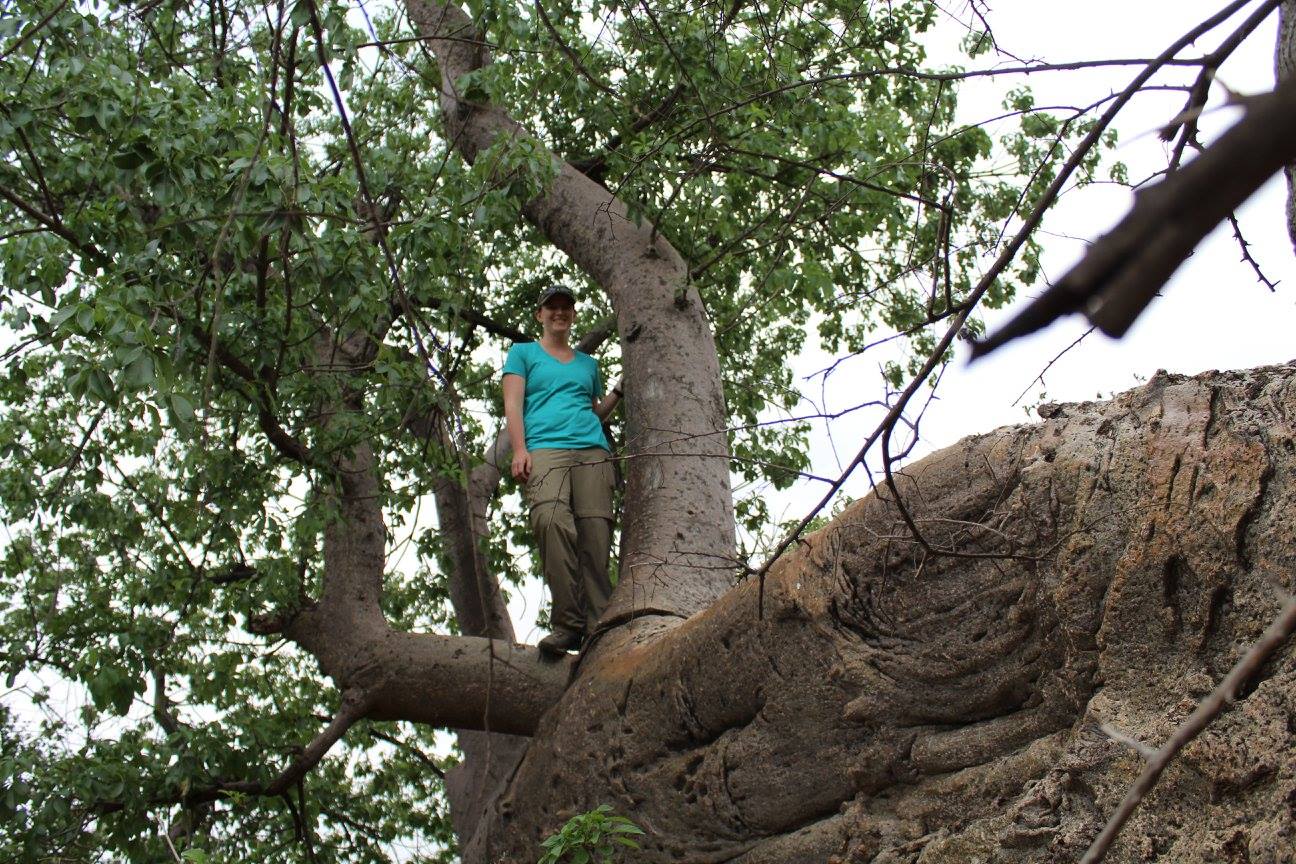
Macy in a baobab tree! Baobab trees can live for well over 1000 years and reach up to 5 m in diameter at breast height, so they make for good climbing.

Fieldwork was fun but arduous and there are many people in Kenya to thank! A special thank you to Macy’s local host Daniel Ngei and his family, the local chief Joseph Kavui and all the landowners in the villages of Kaai, Kalesi, Kaluku South, Kandundu, Katithini, Kavui, Kawula, Kiwaani, Mutoleka, Ngieni East, Ngieni West and Yungamaduu who generously allowed us to sample baobabs or others fruiting trees on their lands. Funding for the project came from Bat Conservation Internationa, the Association of Biologists at Texas Tech University, and the Department of Biological Sciences at TTU.

Bats love the baobab flowers, but the fruits are quite a local snack for people. Here they have been dyed green to be sold for $0.05 a bag.

Clutter negotiating ability of forest bats – Our paper in J Exp Biol just published

Most bat community ecologists conceptualize insectivorous bat assemblages as comprising at least three foraging ensembles — the “open-space” ensemble, the “edge/gap” ensemble and the “narrow-space” or forest interior ensemble. The ensembles are generally characterized by different combinations of wing parameters that facilitate flight in those habitats. What’s been less clear is how species differ in performance within these ensembles, and how any differences might map to wing morphology.

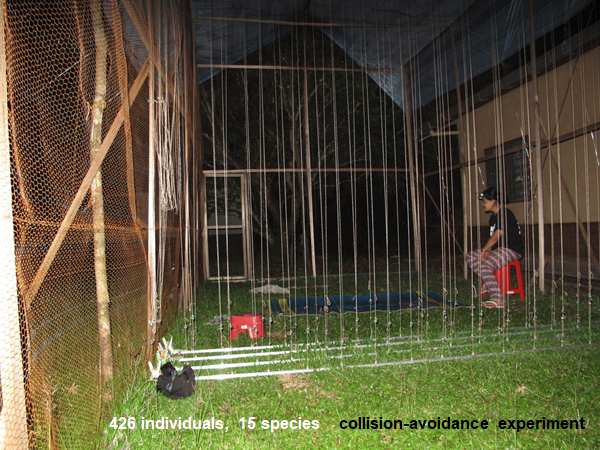
That’s what Julie Senawi set out to do as part of her PhD, assessing performance of 15 species of forest interior bats through a collision-avoidance. There are a number of challenges in inferring ability from performance on tests, so we borrowed form the social sciences and applied Rasch Analysis, a latent trait modelling approach related to Item Response Theory. Details of this approach and the findings were published this week and can be requested through my researchgate page:

Senawi, J. & Kingston, T. (2019). Clutter negotiating ability in an ensemble of forest interior bats is driven by body mass. J. Exp. Biol. doi:10.1242/jeb.203950

The title says it all!

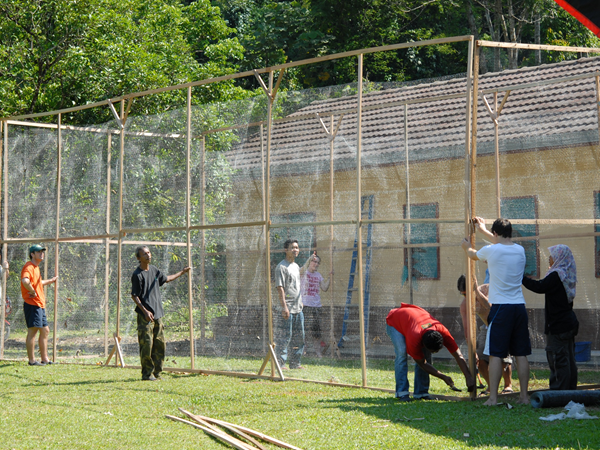
Building Julie’s flight cage
4 banks of strings that could be set to different inter-string distances made up the collision-avoidance experiment.
Julie taking photos of the bats to extract wing dimensions

Congratulations to Iroro – a prize winning week!

A great week for Iroro! First she won the Karl Koopman Award for a Student Oral presentation at the 49th North American Society for Bat Research (NASBR) meeting in Kalamazoo. Her talk was entitled “Competitors Versus Filters: Drivers of non-random Structure in Forest Interior Insectivorous Bat Assemblages along Elevational Gradients”.

Icing on the cake came from placing third in TTU’s “Three-Minute Thesis” competition

https://www.depts.ttu.edu/gradschool/current/threeminutethesis.php

Tigga receives NASBR’s Gerrit Miller Award

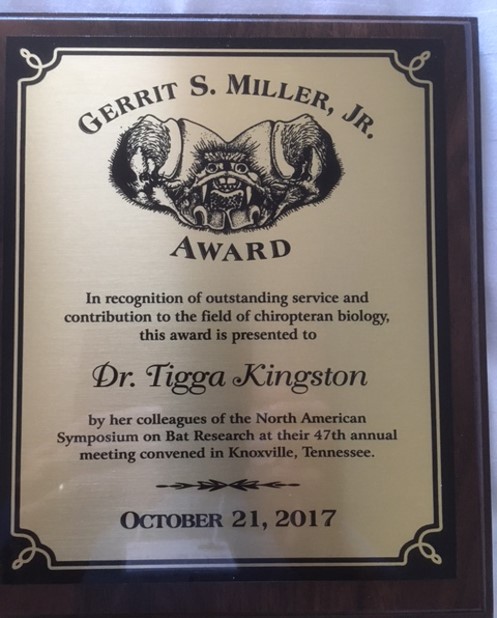
I was deeply honored to receive the Gerrit S. Miller, Jr  Award from the North American Society for Bat Research at NASBR’s annual conference last week. The award is in recognition of “outstanding service and contribution to the field of chiropteran biology”. I am the 26th awardee in the Society’s 47-yr history, so it is very special to me!

The newest Miller Awardee about to be photobombed by one of the oldest (Roy Horst)

The fabulous plaque!


One of the best bits of the award is the complex conspiracies that go on to keep it a secret from the recipient until “the big reveal” at the conference banquet. Thank you to all the co-conspirators for making it so special — you know who you are!!!


Kate Barlow Award 2018 for graduate research benefitting bat conservation

We are pleased to announce that applications to the 2018 Kate Barlow award are now open – the closing date is 5pm, 4th December 2017.

The Kate Barlow Award aims to encourage the next generation of bat researchers by providing a substantive contribution towards the research costs of postgraduate students undertaking research that will benefit bat conservation, in honour of the late Dr Kate Barlow’s contribution to bat conservation.

  • The Kate Barlow Award is open to students anywhere in the world conducting research which has a direct relevance for bat conservation.
  • One award of up to £4,500 will be made, towards the costs of a bat research project of no less than 4 months duration.
  • In addition BCT will pay for the award winner to attend either the BCT National Bat Conference or another relevant bat research and conservation conference.
  • An award decision will be made by the end of February 2018.

To apply, a completed application form together with two letters of recommendation should be emailed to science@bats.org.uk. The application form and guidance notes can be found on our website here:  http://www.bats.org.uk/pages/the_kate_barlow_award.html

Kate Barlow and a phyllostomid friend in Colombia, 1993 – great times (Photo T. Kingston)

Ph.D position on Physiological Ecology of Flying Foxes in Australia — McGuire Lab at TTU

My colleague here at TTU, Dr Liam McGuire, has an awesome PhD position available. See the advert and contact details below:

The McGuire lab at Texas Tech University is looking for a highly motivated PhD student to work as part of an NSF-funded collaborative study of flying foxes and Hendra virus in Australia. The successful applicant will work with an international and multidisciplinary team of collaborators, seeking to understand how human influences affect Hendra virus spillover events. As human development clears native forest resources, flying foxes that are traditionally nomadic or migratory have increasingly established permanent resident camps in urban and peri-urban areas. The PhD student will lead efforts to study the nutritional ecology, foraging dynamics, energetics, and stress physiology of resident flying foxes compared to migratory populations. Experience working with bats is an advantage, but more important is experience with ecophysiology methods such as energetics, nutritional physiology, and stress physiology. Fieldwork will extend for periods of up to 1 year in Australia, and therefore the successful candidate must be independent, motivated, and well organized, able to work well with a large team of collaborators under challenging field conditions. Another PhD position related to the project will be available in the Plowright lab at Montana State University, focusing on immunology and virus dynamics in flying foxes.

Anticipated start date for the position is January 1, 2018. For more information about the project, contact Liam McGuire (liam.mcguire@ttu.edu). The position will be based at Texas Tech University in Lubbock, Texas, but extended periods of fieldwork will be conducted in Australia. Interested students should send a CV and brief summary of relevant experience to Liam McGuire (liam.mcguire@ttu.edu).

Special Issue in Diversity “Diversity and Conservation of Bats” — submissions wanted!

I am the guest editor for a special issue in the journal Diversity entitled “Diversity and Conservation of Bats”. Submissions are due before 31st March 2018, so plenty of time to pull together some great papers!  The scope address the following:  i) the diversity and distribution of bats; ii) the effect of human activities (e.g., landuse change, hunting, roost disturbance, climate change) on bat behavior, populations, diversity, distributions, or ecosystem function; iii) drivers of human activities that threaten bats (e.g., attitudes, knowledge, perceptions, economics); and iv) conservation applications, particularly those that evaluate evidence of success.

For full details, head to the issue page here:

Diversity and Conservation of Bats

Kendra recently published in the journal and had a good experience with them. Once the article is accepted, it is up in the issue almost immediately, and the review process was also very efficient.  So, I look forward to seeing submissions.

Viral richness and cave roosting in bats – Kendra’s paper out today in Diversity

Kendra has a paper out today, with lead author Anna Willoughby and Kevin Olival from Ecohealth Alliance, in Diversity exploring the role of roosting ecology in patterns of viral richness and sharing among bat species. The authors compiled bat-virus associations (from previously published databases) and ecological traits to investigate the importance of roosting behavior on viral richness and sharing. Cave-roosting bats do not host greater viral richness than non-cave-roosting bats, but do exhibit a greater likelihood of sharing viruses, especially between species documented as co-roosting in the same cave.

Willoughby, Anna R.; Phelps, Kendra L.; PREDICT Consortium; Olival, Kevin J. 2017. “A Comparative Analysis of Viral Richness and Viral Sharing in Cave-Roosting Bats.” Diversity 9, no. 3: 35. doi:10.3390/d9030035

The paper is open access and can be downloaded here:  http://www.mdpi.com/1424-2818/9/3/35