Touseef is selected for Verena Fellows in Residence Program

Touseef has been selected for the inaugural cohort of the Verena Initiative Fellows in Residence Program to build upon his existing research work. He will conduct his lab work at Colorado State University in June 2023 in collaboration with Dr. Anna Fagre, who is Research Lead for Biology Integration at Verena.

The Inaugural Cohort of the Verena Initiative Fellows in Residence

This fellowship will enable Touseef to build upon his existing research work by including bat-borne DNA viruses’ propagation. He will be investigating the impact of heat stress and dietary deficiency in propagation of DNA viruses by Indian flying foxes in the environment.
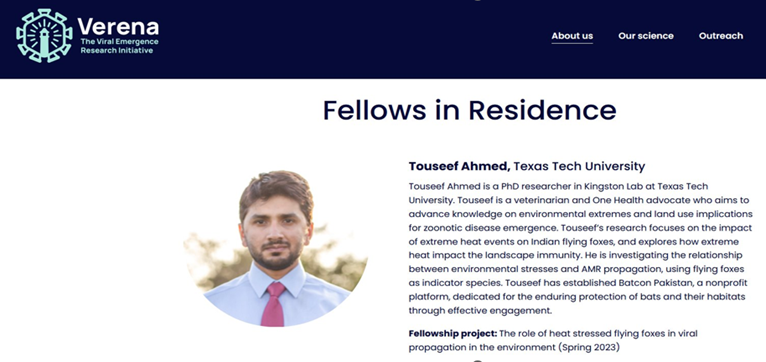
Verena Fellows in Residence Profile. Find More here.

Another Feather in the Academic Cap – Ben and Iroro’s Latest Publication from Their Bat-venture in Nigeria is out!

Aren’t we all good students? Let’s hope the members of the Kingston lab can keep up with that pace!

Looks like Iroro is having a fruitful night! Told you to make sure the harp traps are in good shape. Those strings could use a bit of TLC, aside from our bat friends of course!

Just recently, Iroro and Ben teamed up to publish another portion of their findings from their bat-venture in Nigeria! Together with their co-authors, they discovered that the diversity of Afrotropical bats isn’t as depauperate as previously thought. In fact, they found that the Afrotropical bat diversity is comparable to that of other ecoregions, such as those in Peninsular Malaysia and Indonesia. Their conclusion? The underrepresentation of the Afrotropical bat diversity stems largely from undersampling the species-rich narrow ensemble. And why is that you ask? Well, it’s simply because earlier studies did not include harp traps in their surveys! So, Y’all, make sure those harp traps are in good shape, strings included, so you won’t miss out on any adorable, fuzzy, nocturnal winged creatures!

Check out Iroro and Ben’s findings!

Touseef Presents Poster on Future Directions for One Health Research at 7th World One Health Congress 2022 in Singapore

Touseef posed in front of his poster titled “Future directions for One Health Research; Regional and Sectoral Gaps

A competitive Travel Award by the Congress Organizing Committee enabled Touseef to attend the 7th World One Health Congress in Singapore to present his research “Future directions for One Health Research: Regional and Sectoral Gaps”. The concept of One Health highlights the important inter-relationships between health and well-being of people, animals, plants, and the environment which supports their existence. However, implementation of a One Health approach varies considerably between different geographical regions and remains challenging to implement without greater inclusivity of different disciplinary capacity and expertise. Identifying regional and sectoral gaps will help achieve One Health research parity.

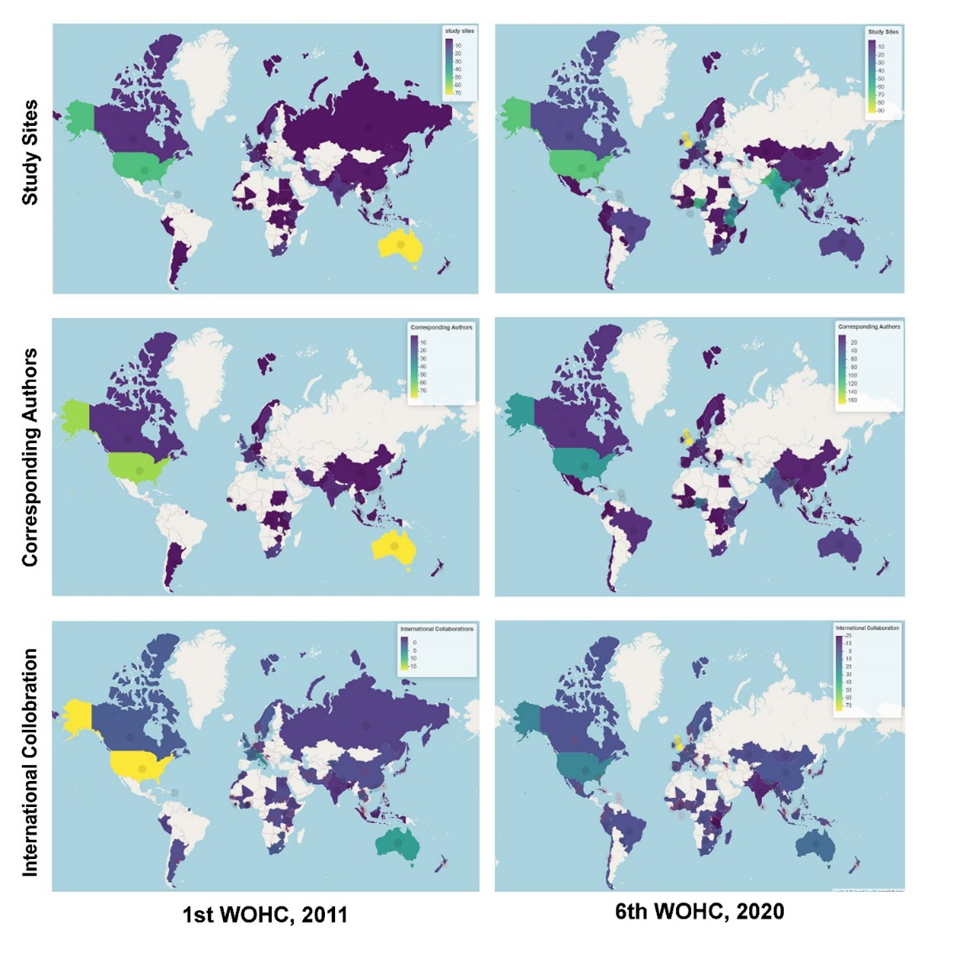
Geographic distribution of One Health research. Comparison of abstract distributions from 1st and 6th World One Health Congress based on study sites, affiliation of corresponding authors, and international collaborations. Contributions to international collaborations were calculated as the difference between the number of studies conducted in the country and the number of corresponding author affiliations from the country. Negative and positive values indicate sink (received collaboration) and source (extended collaboration) of One Health research. Source countries such as US and UK for the 1st and 6th WOHC are indicated by yellowish green color while sink countries such as India and Pakistan for both Conferences are indicated by dark blue color. Check out our interactive web maps here!